
Company Registration
By admin / June 4, 2026 / No Comments / Corporate & Business Law
Corporate & Business Setup
Company Registration in Thailand: The Definitive Guide
What is Company Registration?
Company registration is the official legal process utilized to establish a business as a distinct juristic person recognized by Thai government authorities. This statutory status grants an incorporated company independent legal rights and duties separate from its owners. Consequently, a registered entity can lawfully execute commercial transactions, enter binding contracts, own assets, hire staff, and manage liability cleanly, while significantly boosting core credibility with partners, investors, and banking institutions.
Types of Business Structure
Commercial registration architectures under Thai corporate guidelines are split into two primary paths based upon ownership and liability frameworks:
Sole Proprietorship
Tailored primarily for small-scale, single-owner retail setups or simple digital shops.
- Liability: Unlimited personal liability over all operational business debts.
- Taxation: Net business revenues are taxed directly at individual personal income rates.
- Limits: Faces reduced structural credibility and limitations in accessing commercial bank financing.
Juristic Person Registration
Establishes a completely separate legal entity, restricting shareholder liabilities safely to their investment limits.
- Ordinary Partnership: Formed by at least 2 people; all partners retain unlimited debt liability.
- Limited Partnership: Features both general partners (unlimited liability & management rights) and limited partners (liability capped to investment, no management control).
🏢 THE PREFERRED OPTION: LIMITED COMPANY (CO., LTD.)
Requiring a minimum of two distinct individuals, a Limited Company structures ownership via shares. Shareholder financial exposure is securely capped strictly to the value of their registered shares. This framework offers the highest corporate credibility, streamlined management systems, and optimum flexibility for raising capital.
Key Corporate Roles
Incorporating a limited company requires organizing three distinct structural groups:
- Promoters: The founding individuals who initiate the initial setup. At least two promoters must reserve the corporate name, prepare the foundational Memorandum of Association, and arrange the mandatory statutory meeting. Promoters can transition into shareholders or directors later.
- Shareholders: The official owners of the entity holding capital shares proportionate to their investment. They are liable for paying up share allocations, possess voting rights in general meetings, and receive corporate dividends.
- Directors: The operational executives formally elected by shareholders to legally manage, sign for, and represent the company in strict alignment with its registered objectives and corporate bylaws.
The 9-Step Registration Process
The standard corporate incorporation path in Thailand consists of nine vital steps:
- Strategic Structure Selection Evaluate your capital scale and finalize whether a Sole Proprietorship, Partnership, or Limited Company best suits your long-term operational needs.
- Documentation Preparation Compile all statutory applications (Forms Bor.Jor. 1, 2, 3, 5, Form Wor., Form Kor.), collect certified identity copies from founders, and prepare draft bylaws.
- Corporate Name Reservation Submit up to three unique names via the Department of Business Development (DBD) online platform. Names must not resemble existing brands or utilize restricted words (e.g., royal terms, country names).
- Register the Memorandum of Association (MOA) File the approved MOA with the registrar within 30 days, officially defining the core company name, registered head office address, business scope capital, and promoter details.
- Share Subscription Allocation Formally open share subscription allocations, ensuring every registered promoter and initial investor holds a minimum allocation of at least one share.
- Convene the Statutory (Founders) Meeting Gather the founders to formally adopt company regulations, ratify promoter expenses, elect the initial board of directors, and officially appoint a licensed auditor.
- Establish the Board & Call Capital The newly elected directors assume control, calling in share capital payments. A mandatory minimum threshold of at least 25% of the total share value must be collected.
- Settlement of Registration Fees Clear all statutory processing costs. Basic government fees generally scale across fixed units: a 5,000 THB company registration fee, a 500 THB MOA fee, along with small certificate copies and stamp duties.
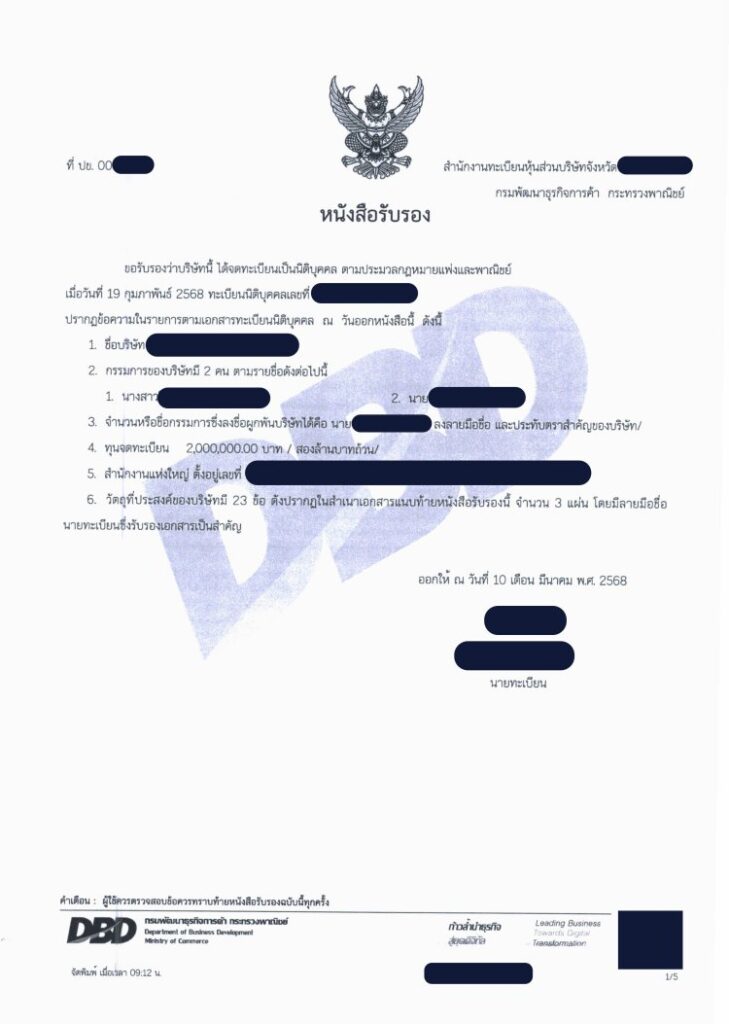
- Acquire the Corporate Certificate Collect the official Company Certificate and registration papers from the DBD registrar. The company is now recognized as a completely operational juristic person.
Available Incorporation Methods:
1. Online (DBD Biz Regist)
Highly convenient, utilizing secure digital signatures to bypass government office travel completely.
2. Legal/Accounting Firm
The safest path for foreign investors, ensuring absolute regulatory compliance and error-free execution.
3. In-Person Filing
Filing directly at the local DBD branch office; can be finalized in a single day if paperwork is flawless.
Advantages & Statutory Considerations
Operating through a formal registered limited framework guarantees distinct commercial benefits:
- Limited Liability Protection: Safeguards personal wealth, bounding financial liability strictly to unpaid share capital levels.
- Capital Fundraising: Enables swift expansion capabilities by permitting the issuance of new equity shares to incoming global investors.
- Tax Optimization: Corporate tax frameworks offer corporate rates that are often lower than progressive personal tax brackets, paired with expansive legal expense deductions.
⚠️ ONGOING STATUTORY COMPLIANCE MATTERS:
- Value Added Tax (VAT): If your gross annual revenues surpass the 1.8 million Baht threshold, the corporate entity must legally apply for VAT registration with the Revenue Department within 30 days.
- Accounting & Auditing: All companies must maintain professional corporate accounting records and submit annual audited financial balance sheets to the DBD and Revenue Department without fail.
Foreign Business Ownership Framework
For international investors looking to establish operational roots in Thailand, corporate structures operate under unique legislative restrictions:
1. The Foreign Business Act (FBA) Boundaries
The FBA strictly restricts foreign equity shareholding to a maximum limit of 49% for designated service and retail industries. If a company is categorized with more than 49% foreign ownership, it is legally defined as a foreign entity and cannot operate unless it holds a specialized permit.
2. Pathways to Achieving up to 100% Foreign Ownership
International entities can safely bypass the 49% threshold through three primary legal frameworks:
- Board of Investment (BOI) Promotion: Grants foreign businesses up to 100% equity ownership alongside premium tax holidays, import duty exemptions, streamlined foreign expert visas, and unique land ownership permissions.
- US-Thailand Treaty of Amity: Exclusively permits American individual citizens or corporate entities to maintain majority or full 100% shareholding control, excluding a few protected categories like communications or banking.
- Foreign Business License (FBL): A unique operational license applied for directly through the DBD. This framework requires an extensive minimum registered capital baseline of 3 million Baht per restricted activity.
💼 FOREIGN EMPLOYMENT & WORK PERMITS:
To legally secure a single foreign Work Permit and long-term visa within a Thai corporate entity, the company must maintain a minimum registered capital block of 2 million Baht and strictly employ a ratio of 4 full-time Thai staff members for every 1 foreign employee.